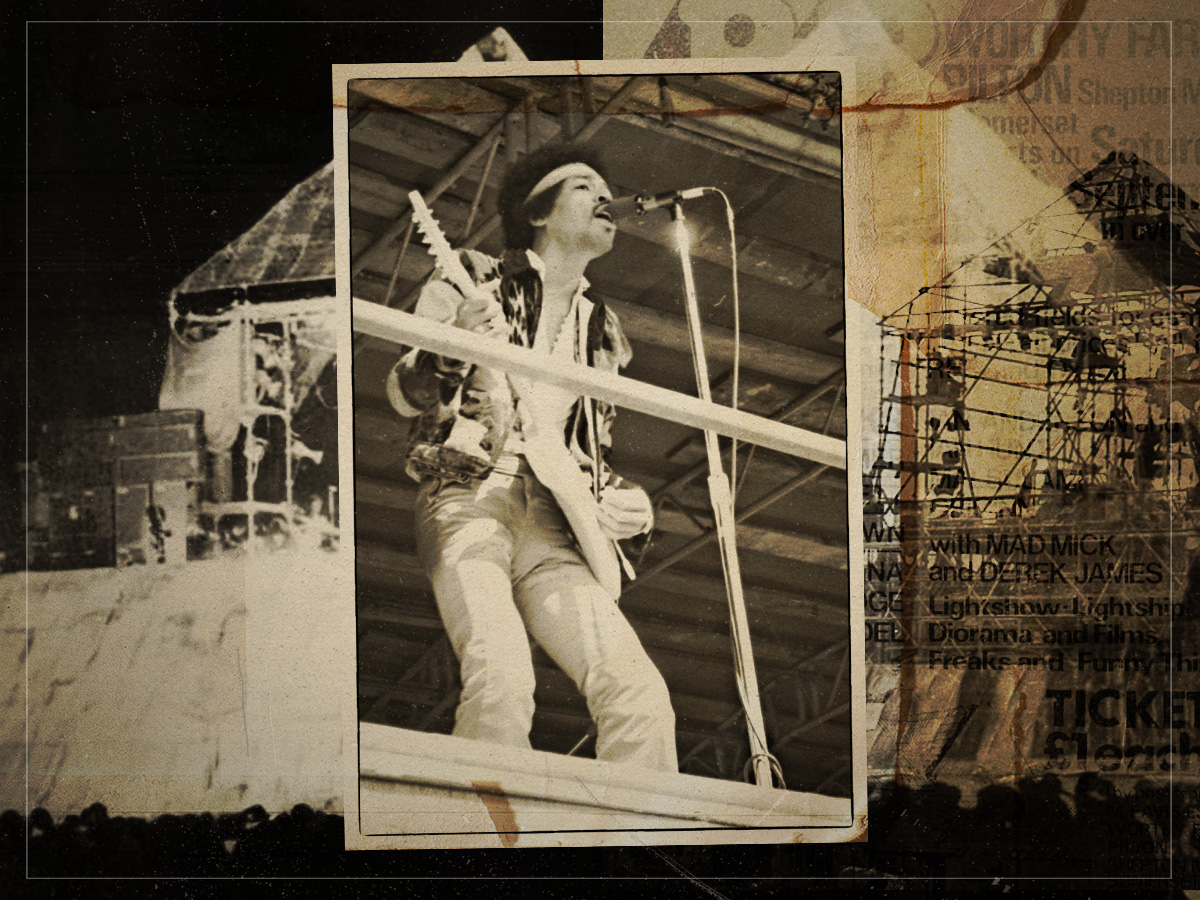
September 18th, 1970, was the day music died… but then was born again, all in the space of less than 24 hours. That might sounds strange, almost as if some kind of sonic resurrection of Jesus took place, but in many ways, there’s no better testament to everything that Glastonbury Festival has achieved than the coincidental date it shares in a seismic piece of music history.
The first-ever trek to Worthy Farm wasn’t exactly the roaring success that you’d think it would be. In all honesty, it was a bit of a financial disaster, with tickets underselling on a massive scale and founder Michael Eavis really having to put his money where his mouth was – both literally and figuratively. Nevertheless, something in the ether kept Glastonbury afloat in its inaugural year – and it might just have been the guitar god who was newly looking down from the heavens.
You see, September 18th, 1970, wasn’t just a significant date for the dawning of Glastonbury – it was, in fact, the day that Jimi Hendrix died. This was a tragedy that obviously shook the world, with the guitarist, in all his short 27 years of life, completely changing the game of rock music forever. However, his imprint on the scene of live music was even more seismic, and one that made the successful destiny of Glastonbury even more inevitable.
Hendrix was never booked to play at Worthy Farm – that headlining role was assumed by Tyrannosaurus Rex – but you can’t shake the feeling that he must have had some ethereal hand in its fate from above. After all, he was the king of an iconic festival set, and as Glastonbury beckoned in a whole new era and definition of what mass live music was meant to be, it’s clear that they would have looked to previous performances like Hendrix’s for inspiration.
For starters, there was his performance at the Isle of Wight Festival, which took place only weeks before, on August 31st. Becoming one of Hendrix’s most famous performances, not just for the fact that it was his final one on British soil, but for the reason that he was curiously off-kilter. Having indulged himself a little too heavily in hallucinogenics before hitting the stage, Hendrix just wasn’t his usual self, manifesting in a sub-par set, including telling the audience to go and buy hot dogs halfway through.
In this sense, he was a shadow of the show he put on at Woodstock the year prior, even though the Isle of Wight was to a far larger audience. His set as the sun rose on the Monday morning of the festival became undeniably his most iconic for his sheer six-string brilliance and erratic style, and it would be this legacy he would always be remembered for.
Although he never got the chance to grace the Glastonbury stage, you can imagine it would have been an opportunity Hendrix would have jumped for, if given the chance. His principles of peace and love are ones that very much line up with the ethos of the festival itself, almost as if Eavis received a calling from the heavens above that this should be the path it would take. If one thing’s for certain, Hendrix would have been on board.
Now, some 55 years on from that seismic weekend in music, the legacies of both events stand as enduring moments that changed the face of rock, both in very different ways. Hendrix’s death may have marked a tragedy to the scene, but the birth of Glastonbury only proved that his life’s work of iconic live performances would be continued through the mantle of the litany of other artists who rode on his coattails and worshipped the ground he walked on. In many ways, in a spiritual sense, you could argue Hendrix’s parting gift to the world was Glastonbury, because he somehow knew the future of festivals was in the safest of hands.