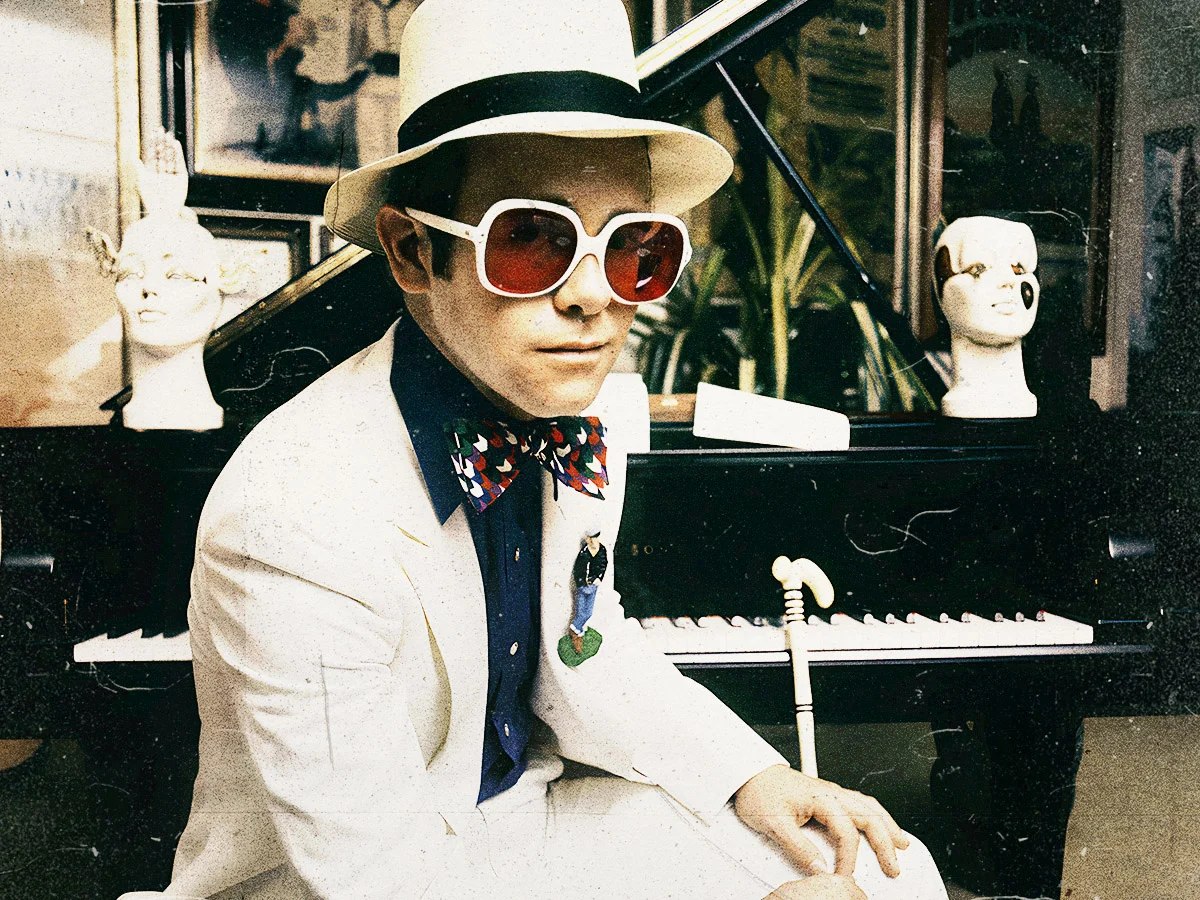
For Elton John, everything he’s ever done has been a byproduct of quintessential rock ‘n’ roll. As he once said, “I was brought up on rock and roll. I’ve always been into rock and roll. That’s my favourite sort of music.”
Far more than just your usual “hip” musician adorned in overly flamboyant attire behind a massive piano, John brought a different flavour of rock ‘n’ roll to the stage, embellishing his sets with just the right amount of pressure to keep it high-energy. But for John, it was never about reinventing the wheel or doing what others had done before – not really. There was always an element of paying homage to his heroes to some degree, but it never crossed into imitative.
For John, it was actually about never being boring. No, really – for him, being rock ‘n’ roll didn’t mean subscribing to a subset of criteria but keeping music fresh and exciting, especially in live spaces. As he explained to New Musical Express in 1971, “I don’t want to sit down and do slow things all night. I’d go to sleep. No, really, I’ve been a rock and roll freak for a long time. Rock ‘n’ roll music is the most important music to me. So I’m not going to sit there and sing all these boring songs.”
While keeping shows high-energy also opened a door that made people think they could tell him who he was supposed to be more like, like Randy Newman, or apply expectation where there really needn’t be any, John saw rock ‘n’ roll as a capture all term for a specific mindset on stage where energy was palpable and music centred around emotional reaction. Despite his later bitterness, he used The Rolling Stones as a blueprint, specifically Mick Jagger, and his extraordinary contortionist ways on stage.
A lot of this, John explained, was because they had a nonchalance about them that basically said they didn’t care how they would be perceived, enabling a certain kind of liberation that meant they could do whatever they wanted the moment they set foot on stage. And it worked, because it’s not only what the audience expected, but what they wanted, too.
“I mean that’s Jagger, he can get away with it,” John said. “Probably one day I might do it, but I’d probably feel terribly guilty about it later.”
He continued, “They’re perfect. I mean, Jagger is the perfect pop star. There’s nobody more perfect than Jagger. He’s rude, he’s ugly attractive, he’s brilliant. As I said earlier, The Stones are the perfect pop group, they’ve got it all tied up.”
“They’ve beat The Beatles into a cocked hat in that category,” John added. “The Beatles were a bit showbiz, but The Stones are just sort of ‘oh bugger off’ and I love that. That’s why I love them so much, they don’t give a shit.”
While he discussed the impact of others like Pete Townshend, he regarded Jagger as someone in a completely different category, an “ego-maniac” who just shattered convention and broke down barriers because, put bluntly, he didn’t give a damn. Unlike down-to-earth people like Townshend, Jagger had the attitude to go with the abrasive on-stage persona (“He’s a bitch,” John said), and it incited a different kind of excitement among audiences who just can never seem to get enough of it.
John might have later had some choice words to say about the band and Jagger’s partner in crime, Keith Richards, but they were also his initial point of entry when learning all about what rock ‘n’ roll is and should be. The Stones were his first gateway into the kind of artist he could be on stage, and while he never adopted many of the same traits that Jagger perfected in those spaces, there’s no denying their persistent presence in everything he does.