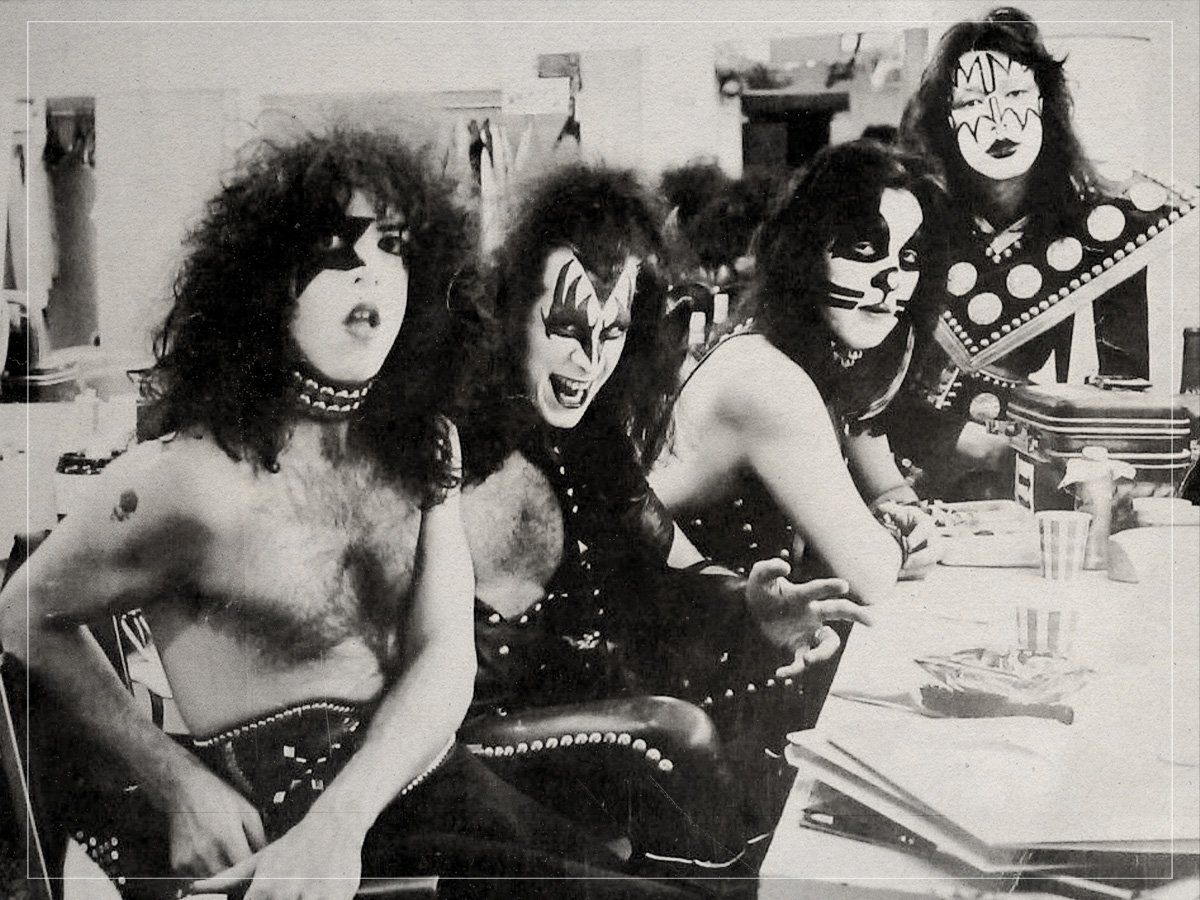
New York hard rock stalwarts Kiss forged an almost mercenary road to their highly sought-after fame and fortune.
And boy, they found it. One of the biggest-selling artists of all time, with over 75 million records behind them, not to mention mountainous levels of official merchandise that’s speculated to have made over a billion, Kiss have cemented themselves in the rock canon, and all it took was a slap of greasepaint, fake blood, and some on-stage pyrotechnics to boot. Having floated around aimlessly as Wicked Lester, Paul Stanley and Gene Simmons looked to the glam era for their much-needed vehicle to the charts.
Forming the classic line-up with Peter Criss and Ace Frehley, a string of respectable rock attack strutters would score the new Kiss juggernaut, reaching their acclaimed crescendo with 1976’s Destroyer. Creative juices would fry from the 1970s’ close, however, dodgy disco detours, conceptual fantasy misfires, and the tacky unmasked era upsetting the Kiss mystique, but, along with their comic escapism and likenesses slapped on every product imaginable, Kiss enjoyed a glitter stomp that gave Alice Cooper or Zolar X a run for their money.
The key was the unfussiness. No peacocking axe shredding or hectic fret showboating, their outlandish theatre was married with rock at its most direct. It was part of the business plan, so to speak. While never impeding creativity, Kiss was chasing the tried-and-tested melodicism and enduring songwriting over the emerging metal penchant for furious riffage and speed headbanging. It served them well, finding fame beyond the genre confines of the rock world.
Stanley spoke candidly over the years about his simplistic approach, favouring mood over technical virtuosity. “A solo has got to be so much more than playing in the right key,” he told Guitar Player in 2023.
“It’s about the expressiveness and the emotion,” he added. “I think that comes more from a solo that somebody can sing. That’s going to have more emotion in it than somebody doing acrobatics. I may be impressed by the acrobatics, but it does nothing for me emotionally”.
He added, “I’m not that kind of player, and I’m not interested in others who do that. I certainly respect and appreciate people who can play with dazzling speed and cram more notes into a measure than the average player, but it does nothing for me. It’s an exercise in futility. It’s nothing more than gibberish”.
While many in the rock world were enamoured with Eddie Van Halen’s tapping electricity, Stanley kept things grounded in a realm that would forge a happy marriage in the pop sphere, and it worked.
Kiss would sail through a roll call of celebrated lead guitarists much-loved by the Army fanbase, across Vinnie Vincent, Mark St. John, Bruce Kulick, and Tommy Thayer, but Stanley always bestowed high praise on the original spaceman who laid down those sparkling riffs all those years ago, highlighting in particular his considered solo technique and thematic sensibility that imbued his work.
“Ace and I played well together,” he reminisced. “We really did”.