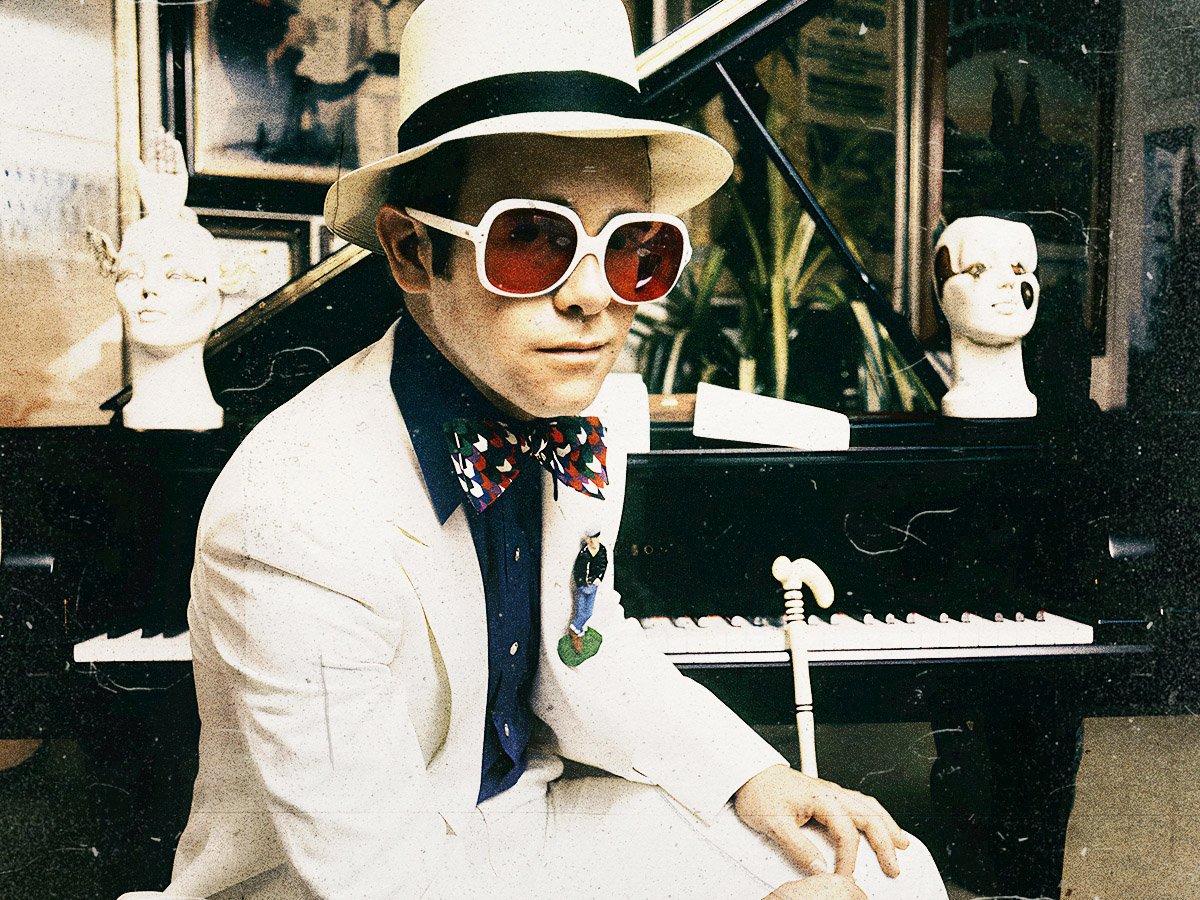
What a year 1973 was for music. Psychedelic rock flourished under the name of Pink Floyd, while Paul McCartney announced Wings as a serious follow-up outfit with Band On The Run. But it was also the year Elton John truly announced himself as the songwriter we would all come to glorify in years to come.
Of course, Goodbye Yellow Brick Road wasn’t his first record, but it was the first that allowed him to spread his creative wings and start becoming the expressive musician he was so famed for being. Shedding his skin of insecurity one song at a time, when Goodbye Yellow Brick Road rolled around, he was an entirely new being, confidently stepping into his charismatic persona.
It was a succinct concept that celebrated so many monster hits. ‘Candle In The Wind’, ‘Bennie And The Jets’, and ‘Saturday Night’s Alright (For Fighting)’ all came from this iconic record, which saw a musician operating at his creative peak, without hesitation. Ultimately, that’s an attribute we regard as creative fearlessness, but with retrospect, Elton looks back on it as something completely different.
“The naiveté is the most pleasant thing about this record, probably,” he explained, adding, “It was a very exciting time in my life. It was a time that we had no fear, nothing was beyond us. It’s a wonderful thing the young have when they get on a roll. We were running on momentum and adrenaline. And then if you’re a talented enough artist, you find your place within the playing field. And this was our example of being at the height of our creative powers.”
The naiveté manifested itself in a number of ways. The first, is as Elton alludes to a creative naiveté. Because Elton and Bernie Taupin’s career was on the slow ascent at that time, they were not operating under the crippling pressure of delivering a monster follow-up record. They could still shoot from the hip in some sense, and try whatever ideas felt natural to them, and ultimately, that can be heard on the record.
The naiveté also stems from a time of behavioural innocence for Elton. Speaking about this record, he once said that while listening to the record, he “cried a little at it because it reminded me of a time when I was very innocent. I hadn’t done a drug.”
Goodbye Yellow Brick Road might just represent the last chapter of sonic sobriety in a story that’s riddled with dangerous hedonism thereafter. This was a record where Elton was operating on pure talent and creative curiosity alone, and the very fact that it’s considered one of his best makes that fact more painful for the songwriter.
It’s unsurprising that the pain of lost innocence feels so palpable for Elton on this record, because it was just two years later when it all came to a head and he suffered a cocaine overdose during his ‘Elton Week’ string of performances in Los Angeles. While the music still got made and released, his personal life descended into madness, and nothing quite like Goodbye Yellow Brick Road was ever experienced again.