As people took their seats and the lights dimmed in London’s BFI IMAX for the world premiere of David Gilmour’s concert film, the audience was instantly transported to Rome for a magical and immersive evening at the Circus Maximus.
Before David Gilmour Live at the Circus Maximus, Rome started, a short video played with the iconic Pink Floyd guitarist and vocalist narrating, “I’m David Gilmour, and I’m a f***ing legend.”
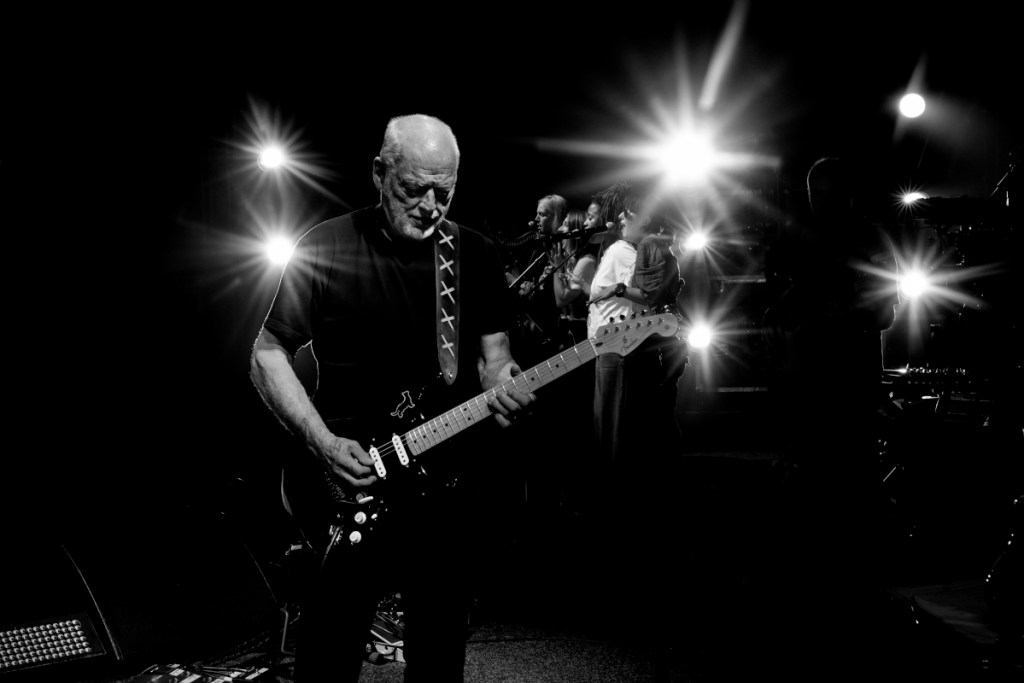
If the audience didn’t know that already, they sure as hell will after watching Gilmour deliver a rock masterclass as he effortlessly commands the stage for two and a half hours, performing Pink Floyd classics and new music from his solo album, Luck and Strange.
The Gavin Elder-directed concert film captures Gilmour’s 2024 return to Rome’s Circus Maximus, an ancient entertainment venue developed by Julius Caesar and used for chariot racing, which became a pilgrimage site for rock and roll for the evening.
“I’ve developed a love for those beautiful, old places that have a sense of history, the feeling of people’s footsteps who have been walking in those colonnades for 2000 years,” Gilmour tells American Songwriter. “There’s a magic to that. That’s why I’ve done ones in Pompeii and a number of the places that I’ve performed because the vibes of places like that aren’t only for filming, it’s for the moment.”
During the world premiere in London, Gilmour watched the film alongside his friends, family, and bandmates on the largest screen in the UK—66 feet high and 85 feet wide—and watching the concert unfold on such a big scale gave the musician a unique perspective of his own performance.
“The ambition has always been to go and see myself and the other people playing, which is one of those impossibilities in life that you can only dream of,” says Gilmour. “In that, wondering about what the experience is like for all the people who have always been out there watching these things that, when you’re at them, have a huge scale.”
He jokes that this is the closest he will get to seeing himself perform live unless he decides to venture down the ABBA Voyage route and use AI and virtual avatars to host a virtual concert.
Gilmour says that Italy has a “magic,” which he can’t quite find the words to describe. It has also played an important role in his career for almost 60 years, from performing in Rome during Pink Floyd’s first world tour in 1968, and studio sessions in the city in 1969, to Gilmour’s iconic return to Pompeii in 2016.
In 1969, Pink Floyd traveled to Rome to record songs for the soundtrack of Antonioni’s 1970 drama, Zabriskie Point. During their two-week stay in the Italian capital, the band also started to formulate ideas for its fifth studio album, Atom Heart Mother,using outtakes from the soundtrack sessions for the album when they returned to London.
“We were at a studio in Rome, and we stayed in a little hotel,” Gilmour says about the Zabriskie Point sessions. “The only time they managed to book for us was 9 at night until 9 in the morning, so we worked all through the night and went back and slept all day. It was fun.”
“It was pretty basic,” he adds. “It was a proper studio, but even then, not quite state-of-the-art. In those days, in London, you would have four tracks. The tape machine, [in Rome] had three. There was a lot of ingenuity required to do all the stuff you want to do with that sort of equipment.”
Perhaps Pink Floyd’s most notable connection to Italy is the band’s now iconic performance at Pompeii in 1971, which was the brainchild of filmmaker Adrian Maben.
“He had the idea of doing an artistic thing in a beautiful place,” Gilmour says. “We didn’t have an audience; it was just us set up, most of it during the daytime. It felt pretty strange [because] you’re not used to playing like that for a film version, where you play one song without an audience and say, “Was that good enough? Oh, we’ll do it again!’
“There’s one similarity to the studio process and another to the live process,” he continues. “Afterwards, we had to do some overdubs in a studio in Paris, where Adrian said, ‘You won’t tell the difference.’ And of course, you could tell the difference.”
Earlier this year, a 4K restoration of the performance, Pink Floyd at Pompeii – MXMLXXII, was released in cinemas, and a new generation was able to witness memorable renditions of “Echoes”, “Set the Controls for the Heart of the Sun” and more of the band’s earlier experimental tracks.
“When it was released [in 1972], it was in a very old-fashioned recording system on videotape, the sort that none of us have seen for years; it was so crude,” says Gilmour. “This time, we had our experts find all of the film canisters. We have a person who does that called Lana Topham, who is brilliant. She found these film canisters, which were stored in different places in Paris, London, and Italy, and had them all cleaned and every frame scanned to 4K and then re-edited as the original, and the sound remixed by Steven Wilson. I found it exhilarating.”
Gilmour also made history when he returned to the amphitheatre in 2016, marking the first public performance at the venue since 79 AD, around the time that Mount Vesuvius erupted.
The recent tour, Gilmour’s first in 10 years, was in support of his 2024 album, Luck and Strange. The singer-songwriter says that his work on Luck and Strange has “pleased him more” and “surpassed” anything he has done musically. Even a year after release, he still listens to the album on a regular basis in a “rather self-congratulatory way.”

The album was produced by Charlie Andrew, about whom Gilmour once told Rolling Stone that he had “a wonderful lack of knowledge or respect for this past of mine.” This direct approach was a welcome addition for Gilmour as it helped achieve the best results.
“One of the problems in life, when you’ve hit the heights of success that we did, is that people tend to be a bit too respectful around you,” Gilmour says. “They agree with you too much. When you say, ‘What did you think of this?’ And they say, ‘It’s great.’ Do you really think that? It’s only helpful to you if people are bluntly honest about what their opinion is about what you’re doing. That’s what I managed to get in Charlie Andrew, someone who was very blunt and very honest in his questions and suggestions, and where we were going with that album.”
For the setlist of the Luck and Strange tour, Gilmour says that he felt a slight pressure to perform Pink Floyd tracks. Nevertheless, he found a nice balance between performing new music from solo albums and Pink Floyd songs as he included tracks from Dark Side of the Moon, Atom Heart Mother, Wish You Were Here, and The Wall.
The Pink Floyd guitarist and vocalist also included “Fat Old Sun” from Atom Heart Mother, which has been a regular feature of his solo concerts since 2006. It was also a track that was put forward for the album Echoes: The Best of Pink Floyd, but Gilmour was eventually outvoted by the other band members.
“It’s probably the first song that I ever wrote,” he says. “It’s about a teenage moment in a meadow by a river when you’re young. I think it captures something, and I’m very, very happy with it. Just like “Comfortably Numb,” it’s a great soundbed to play over, and the guys all love it when we come thrashing in at the end and put the solo to bed. My little Fender Esquire really sings out.”
When watching the concert film, a wave of emotion and surge of adrenaline from the crowd was undeniable when songs like “Comfortably Numb” and “Wish You Were Here” rang out across Circus Maximus.
Gilmour says that during the tour, he was “mostly trying to play new music,” but couldn’t ignore these classic songs because they create a special atmosphere within the crowd as they sing along to every word.
This year marks the 50th anniversary of Wish You Were Here, an album that further cemented Pink Floyd’s legacy as one of the greatest rock bands in history.
Despite the end result being one of the most critically acclaimed and celebrated albums of all time, the early studio sessions proved to be difficult for the band as they were emotionally and creatively drained after the success of Dark Side of the Moon.
“There were moments of torpor in the whole proceedings, Gilmour says. “We had hit the top with Dark Side of the Moon, and this was the next thing we were doing. I imagine there were nerves and that thing that you can beat yourself up with, ‘Can we beat that?’ Of course, you’ve got to discard any thoughts like that and do the best that you can do, which we did.
“Despite some of the moments in the studio where we didn’t really get on with what we were doing and took our time, the end result, you can’t knock it,” he adds. “From that era, it’s probably my favorite album and [‘Wish You Were Here’] is one of my favourite songs.”
Gilmour was joined on the Luck and Strange Tour with his daughter, Romany Gilmour, as they performed a beautiful, yet haunting, cover of The Montgolfier Brothers’ 1999 song, “Between Two Points.”
“It’s a lovely old song that Polly [Samson] and I have loved for years and years since it came out in the ‘90s by The Montgolfier Brothers,” Gilmour says. “Polly suggested that we do a cover, that’s one of the ideas that she’ll throw at me, constantly, and I’m very grateful for that. I don’t often do a cover, but on this occasion, it felt like the perfect fit. Lyrically, it wasn’t the perfect fit for me and my voice, and she suggested we get our daughter Romany to sing it. It’s magical. It’s a lovely song. Despite the fact that I’m not singing on it and I didn’t write it, it still seems to fit into what we do in a perfect way.”
After more than 60 years in the industry, Gilmour has no plans of slowing down, as he revealed that he is currently working on music for an upcoming album.
“I’m [working on new music] but that snowball takes a bit of time to start gathering momentum and building up into something,” he says. “I’m not too far down that process yet, but I’m thinking that it’ll start speeding up at any moment.”