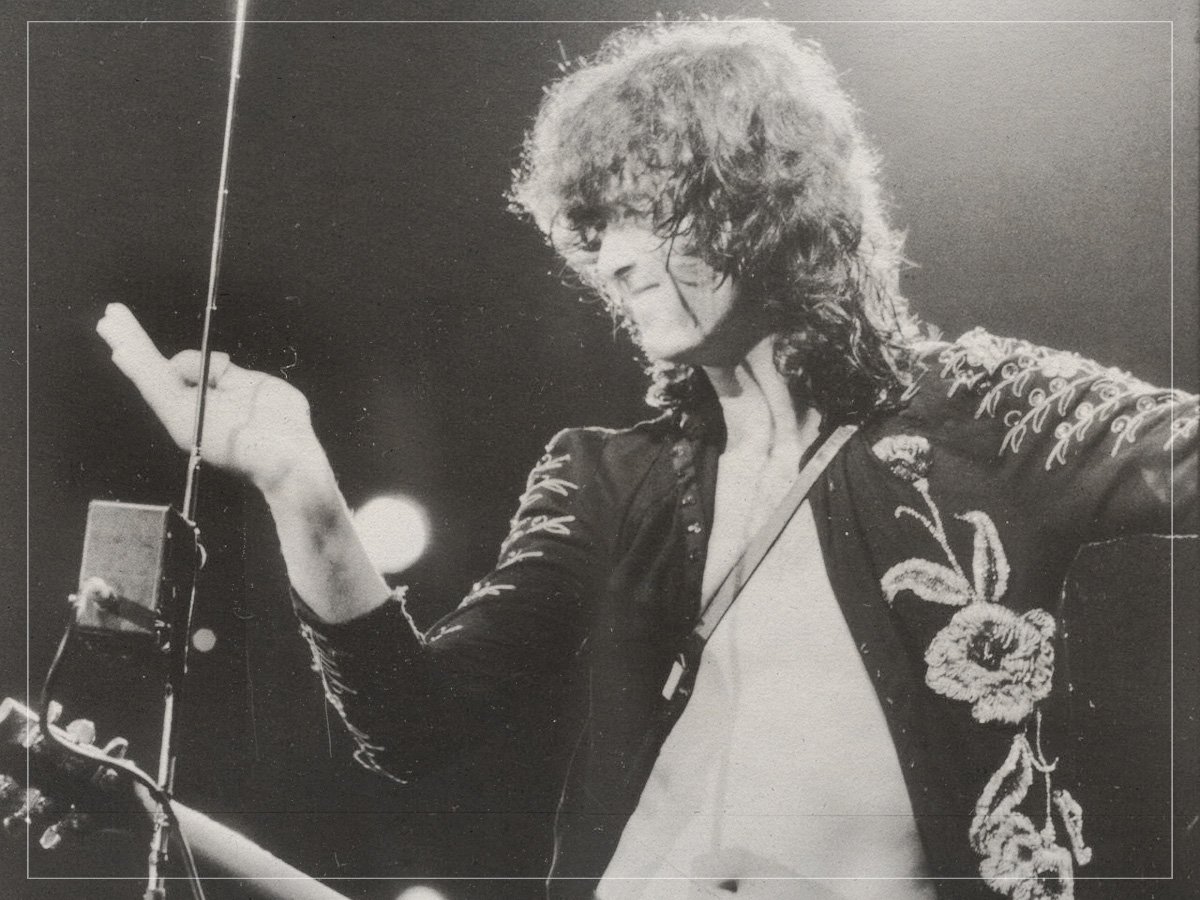
Every self-respecting guitarist has that one riff that will inexplicably emerge from their fingertips whenever they pick up a guitar; a ramshackle connection of notes that, for one reason or another, will not rid themselves from their mind. The difference is, most guitarists aren’t Jimmy Page.
From the moment James Patrick Page first picked up a six-string at the age of 12, he was rarely seen without one. Dedicating day and night to the mastery of this otherworldly instrument, Page quickly found himself among Britain’s most skilled and sought-after guitarists during the 1960s, lending his skills to everyone from Petula Clark to The Who as a session musician.
However, it was only when Page established his own band, in the form of hard rock harbingers Led Zeppelin, that the extent of his skills were placed firmly in the spotlight.
It is no surprise, then, that Led Zeppelin were responsible for the creation of some of rock and roll’s most iconic guitar riffs. From ‘Stairway to Heaven’ to ‘Good Times, Bad Times’, Page’s endless dedication to his craft has simultaneously made him the ire of guitar shop employees and the ultimate hero for guitar players everywhere. Like everybody else, though, Page had that one particular riff that couldn’t help but stick in the forefront of his mind back in Led Zeppelin’s heyday.
While other guitarists might occupy themselves with simple scales or a derivative riff that doesn’t really have the potential to make it out of the practice room, Page’s earworm riff ended up becoming the backbone for one of Led Zeppelin’s most iconic anthems – and, by extension, one of the most beloved hard rock tracks to ever grace the airwaves. “It was always important for me to sketch things out with John Bonham, as there was always so much improvisation,” the guitarist shared of his writing process, per the book 1975: The Year The World Forgot.
“We locked in, with a fusion between the guitars and the drums. There was a great understanding between us,” he continued. That understanding invariably led to the creation of musical excellence. Case in point: “We played ‘Kashmir’ over and over, just the two of us, because it was just this great hypnotic beast, with him appearing to reverse the beat.”
Inevitably, ‘Kashmir’ became a crowning jewel within Led Zeppelin’s discography, and that incredible dialogue between Bonham and Page captured within the track still sounds like the future of music 50 years after its initial release in 1975, on the Physical Graffiti album. What’s more, the song is an unparalleled example of good things coming to those who wait, given that it reportedly took the band three years to perfect the track.
“I knew it was going to be like a round, with all these wonderful cascades on top,” Page revealed of his initial vision for the song. “I couldn’t wait to play him [Bonham] the material as I knew he would really enjoy it.” Those three years spent bashing out the skeleton of the song in the studio was inarguably worth it; not only is ‘Kashmir’ one of Page’s greatest achievements as a songwriter and guitarist, but it sounded unlike anything else being produced back in the mid-1970s.
It was one of many tracks that set Led Zeppelin apart from the wider hard rock scene of the time, cementing their unquestionable position on the upper echelon of rock excellence- a position that the band has managed to maintain through the changing tides of rock history, despite having disbanded decades ago. So, maybe it’s time you poured some more time into that one particular riff that has been bouncing around your mind for some time, you never know what it might lead to.