The rain had fallen gently all morning in London — not in a stormy rage, but with a quiet, respectful sorrow. As if the heavens themselves were mourning. Inside the ivy-draped chapel nestled in the heart of Kensington, the pews were packed with old friends, musicians, and fans — some famous, some unknown — but all united by one name: Jeff Beck.
There was no extravagant spectacle. No jumbotrons, no fireworks. Just a wooden casket draped in white lilies, a vintage Fender Stratocaster leaning solemnly against its side, and silence thick enough to feel in the chest.
The service had reached its final moment when the doors at the rear creaked open once more.
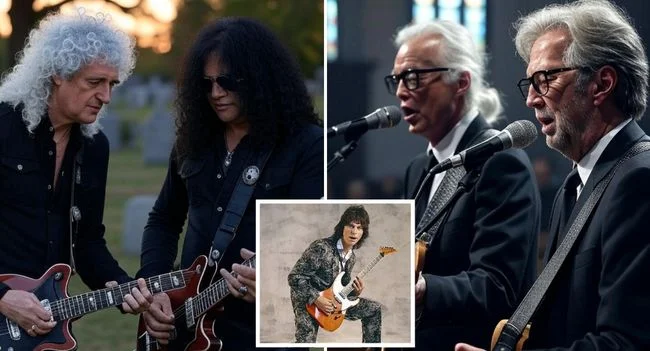
A hush fell across the room as four men, each with their own towering legacy, stepped slowly down the aisle: Eric Clapton, Jimmy Page, Slash, and Brian May. There were no words exchanged, no fanfare. Just nods of mutual understanding — and a quiet pain only fellow musicians could share.
At the front, a small amp had been set up, almost as an afterthought. Clapton was the first to lift his guitar. His fingers, older but still magic, found the first aching notes of “Cause We’ve Ended as Lovers.” It was Jeff’s favorite, and the room trembled under its delicate beauty. Clapton didn’t sing — he didn’t need to. The guitar did the grieving.
Then Jimmy Page stepped forward. He glanced at the casket, whispered something no one could hear, and let his Les Paul speak for him. His tone was mournful, searching, and filled with the kind of phrasing that made the soul ache. It wasn’t a performance — it was a goodbye between gods.
Slash followed. Dressed in black, signature hat in place, he paused for a long second before he even plugged in. When he did, the distortion came not as aggression, but as raw, primal grief. His solo was unrehearsed, improvised — and yet, it soared. Notes bent and cracked like a voice choked with emotion. Some attendees, even hardened roadies, wiped away tears.
Finally, Brian May stepped forward, his guitar glowing under the candlelight. He didn’t play at first. He looked out at the audience, then to the casket, and spoke:
“Jeff was the guitarist’s guitarist. We didn’t come here today to perform. We came to listen — to what he gave us. And maybe, to give just a little back.”
Then came the final notes — not loud, not showy, just pure, melodic, almost too tender to bear. And then, a silence deeper than applause.
Brian turned to the casket and said softly,
“This one’s for you, Jeff.”
There were no encores. The four men stepped back, guitars in hand, eyes down. The chapel remained frozen in reverence. No one moved.
Some say it felt like time stopped. Others swear they heard Jeff’s laughter in the rafters, or the faint echo of his guitar in the air, just for a second.
Outside, the rain had stopped. But inside that chapel, something eternal had been left behind — a final concert not for stadiums, but for one man who changed them all.
And in that moment, the music didn’t just honor Jeff Beck.
It became him.